Learning and organisational development
TPHC’s Learning and Organisational Development (L&OD) directorate builds the capability and culture that health and care organisations need to sustain change. Working with NHS trusts, integrated care boards and national bodies, the team delivers learning programmes, leadership training and organisational development support from team level through to board.
Two products sit at the core of the CPD-certified L&OD offer. Empowered Leadership: Creating Inclusive and Effective Workplaces is a four-day line management course grounded in the NHS People Promise and the Expectations of Line Managers framework, equipping existing and new managers with the skills to lead inclusively, manage performance, and have difficult conversations with confidence. The After Action Review (AAR) Conductor Development programme trains staff to facilitate structured learning reviews within their own organisations, building a self-sustaining culture of reflection. CPD-certified and endorsed within the NHS Patient Safety Incident Response Framework, it has supported teams across multiple NHS trusts since 2021.
The team’s wider offer covers board and clinical leadership development, governance review, and organisational and partnership development, supporting the structural and cultural changes that lasting transformation requires.
Empowered Leadership: developing line management capability across the NHS
Nationally, 82% of NHS managers have never received formal management training. Yet line management is a critical driver of staff experience, retention, and organisational performance, with poor line management strongly linked to low morale, avoidable turnover, and underperformance.
What we did
TPHC developed the Empowered Leadership programme, a four-day CPD-accredited development initiative designed to address this gap. The programme equips line managers with the core skills, behaviours, and confidence required to lead compassionate, inclusive, high-performing teams.
The design was informed by national evidence, including the NHS Leadership Way, NHS People Promise, and NHS Long Term Workforce Plan, alongside insights from staff with lived experience of inclusion, exclusion, bias, neurodiversity, and health needs. We embedded policy and employment relations casework to ensure scenarios reflected the complexity of leading people in NHS settings.
Delivery combines face-to-face small-group sessions with experiential learning (role plays, fishbowl demonstrations, scenario-based practice), bite-sized learning videos on key policies, and a dedicated online platform with resources and guidance.
Increased confidence for managers
All NLPSS line managers completed the four-day programme over a 14-month period. 100% rated it as effective, relevant, and said they would recommend it to others. Managers reported significantly increased confidence in having difficult conversations, giving and receiving feedback, managing performance concerns early, supporting staff wellbeing, and understanding their responsibilities as line managers.
Delegates described the programme as “transformational”, “engaging”, “thought-provoking” and “extremely useful”. One participant reflected:
“No words can quite describe the special learning journey that you are taken on over a 4-week period. The most inspiring and empowering course you could attend. The facilitators ooze passion for the course they lead, and this automatically encourages you to want to do better each and every day.”
Creating a more inclusive, high-performing culture
Over a 12-month period, NLPSS observed a positive increase in appropriate escalations, reflecting greater confidence in addressing poor performance and behaviours rather than avoiding or delaying action. The cohort of trained managers now lead with greater clarity, compassion and confidence, use a shared language and consistent approach to people management, intervene earlier, and contribute to a more accountable, inclusive and high-performing culture.
The programme demonstrates that experiential learning is highly effective for adult learners, peer learning is a major strength, and creating space for lived experience and reflective discussion deepens understanding and empathy. NLPSS is now exploring action learning sets to sustain learning and developing communities of practice for line managers.
Building management resilience: Cambridge University Hospitals’ response to NHS Staff Survey findings
The 2024/25 staff survey results for Cambridge University Hospitals revealed high levels of burnout and a perceived disconnect between senior leadership and frontline reality, including a sense that leaders lacked understanding of the reality staff faced on the ground.
In response, Cambridge University Hospitals launched a mandatory 18-month leadership development initiative for 3,500 leaders across two tailored programmes: one for new leaders and the other for existing leaders. The aim was to build trust and accountability among leaders and between leadership and staff, enable higher-quality conversations across the organisation, and encourage all to live the trust’s values at work.
What we did
TPHC’s expert training faculty supported the design and delivery of both programmes. We worked with the client to refine and recommend changes to programme content, drawing on our own experience of delivering leadership development. We delivered 82 training days and more than 11 action learning set days, with a further 42 delivery days scheduled for Q1 2026/27.
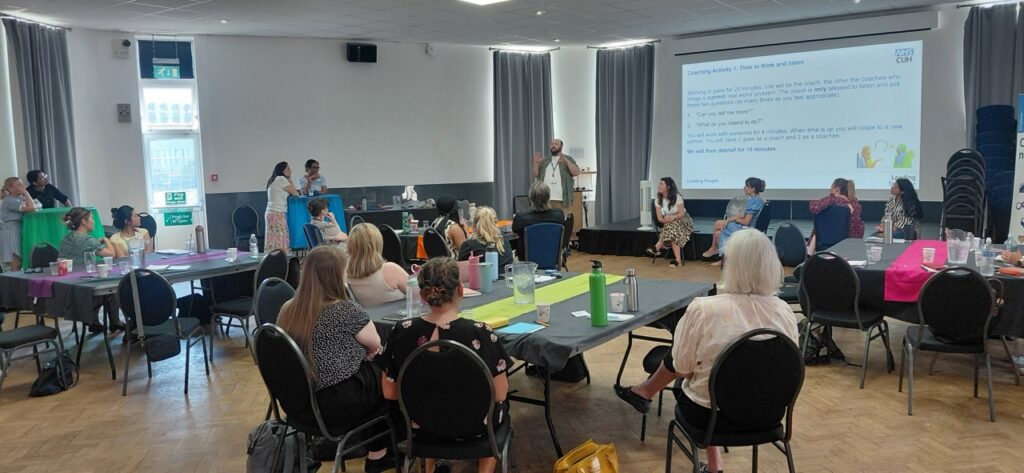
Our expert insight and real-life experiences of inclusion and exclusion strengthened both the leaders we worked with and the programme content itself. This ensured the programme was grounded in lived experience and reflected the reality of leading people in NHS settings.
Building trust and accountability in leadership practice
Participants reported significant increases in their ability to lead through change, lead more inclusively, have difficult and important conversations, and engage in distributed leadership while building greater accountability in their leadership practice. Over 99% of participants who gave feedback said they would recommend the training to colleagues.
Participants described the training as “reflective, supportive, insightful, informative”. Specific feedback highlighted:
“This programme gave me the skills and, more importantly, the confidence to try new things back at work – I’ve been able to take things from the classroom and use them in my leadership practice.”
“The programme has given me the space and time to think more purposefully about the people I lead, leading to insights as to how I can get the best out of each of them. My relationships with my team have strengthened as a result.”
“Good opportunities to build my network and learn from the different perspectives of colleagues in the Trust.”
After Action Review Training: building learning capability across the NHS
After Action Reviews (AARs) are structured debriefs that support learning and improvement following significant events. They are one of the learning tools identified in the Patient Safety Incident Response Framework (PSIRF), which sets out how NHS organisations should respond to and learn from patient safety incidents.
What we did
TPHC delivered AAR training and direct AAR facilitation across the NHS and wider public sector in 2025/26, training over 150 professionals to lead AARs effectively.
By extending our reach into new organisations and sectors, and facilitating a growing community of practice, we supported the development of more reflective, learning-oriented cultures.
Alongside training, our in-house expertise delivered targeted AARs and Before Action Reviews across a range of contexts, from recruitment and process improvement to incident and programme review, helping organisations close the gap between expected and actual outcomes while embedding continuous learning.
Equipping participants with the tools to support effective team performance
Post-training evaluation consistently shows over 95% of delegates leave the training with high confidence scores to conduct AARs, introduce AAR to colleagues, and support effective team performance through learning collectively. Our introduction in 2025/26 of mixed-cohort training, enabling participants to learn alongside colleagues from outside their own organisations for the first time, enriched discussions and broadened perspectives.
Building learning capability within teams
Ongoing support through action learning sets and a community of practice is helping newly trained conductors build confidence in facilitation, embed AARs into everyday practice, and develop their skills over time. Over 150 NHS and public sector colleagues received accredited CPD hours in 2025/26, enabling them to undertake AARs in their own organisations and build learning capability within their teams.
Strengthening learning across the NHS
TPHC’s full-day AAR Conductor Development course holds CPD certification, recognising the quality and professional value of the training as a dedicated conductor development programme. Our in-house conductors have delivered AARs and Before Action Reviews across a range of focus areas, demonstrating our expertise in conducting reviews and training others to do so. This dual capability, training others while delivering high-quality AARs directly, strengthens system learning and supports the embedding of PSIRF principles across the NHS.
Curious to see how we can make a difference?
Interested in hearing more about how we have helped tackle health inequalities? Contact us for an informal chat.
email us at:rf-tr.tphc-communication@nhs.net