
A consumption-based automation platform built by the NHS, for the public sector.
Say goodbye to complex infrastructure and unused bot licences. The DPP is a fully orchestrated, multi-vendor platform that pays you back in time. You only pay for the exact minutes of automation you consume.
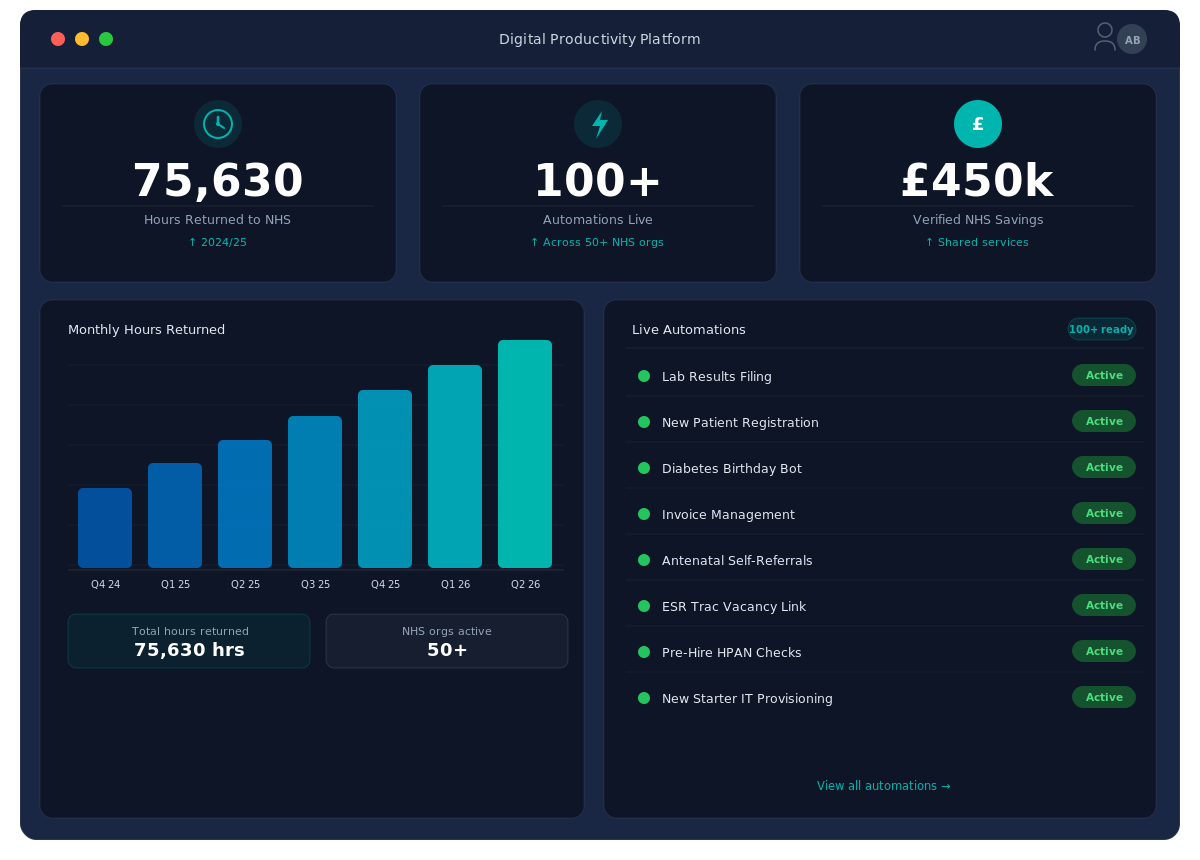
Built for exactly this moment.
The gap between the target and the trajectory
Lord Darzi’s 2024 investigation found the NHS in the foothills of digital transformation, and was specific about what capital starvation had cost: ‘a lack of capital means that there are too many outdated scanners, too little automation, and parts of the NHS are yet to enter the digital era’. Read Lord Darzi’s investigation.
A year later the Health Foundation put the question to 14 clinical, policy and research experts. On current trends they forecast 0.7% annual productivity growth against the government’s 2% target, and put the odds of meeting it at 15%. Asked to assume a properly funded, technology-enabled system, the same experts forecast a mean of 2.2%, enough to meet the target or pass it. They were clear that money alone does not get you there. It takes cultural change, investment in skills, and new operating models. Read the Health Foundation’s productivity forecast.
How the DPP closes it
The DPP is built for that gap. You get automation on a consumption basis, with no capital outlay, no idle licences and no multi-year commitment.
100+ tried and tested automations
Access a growing library of clinical and corporate workflows already built and tested for NHS organisations.
Zero stranded capacity
Rigid contracts and unused bot licences leave trusts paying for automation that isn’t running. The consumption model means you never pay for idle capacity. Bot resource flexes instantly to match demand, and the moment it stops working for you, you stop paying for it.
True economies of scale
Gain access to market-leading technologies without prohibitive upfront costs. By sharing secure, centralised infrastructure, trusts achieve significant cost savings compared to standalone deployments, without compromising on capability or compliance.
Enterprise reliability & exception handling
We continuously monitor process performance across the platform. For one of our managed RPA clients, 31 process automations now achieve 80% or better completion rates, with 24 running at 90%+. System exceptions sit at 2.3%, well below the industry benchmark of 5%. When exceptions do occur, such as legacy systems going offline or unstructured data anomalies, processes are designed to keep running wherever they safely can, recording and reporting each issue for review. Our support team actively monitors exceptions and escalates only those requiring business action to your local team. Every automation is built with this resilience as a baseline, not an afterthought.
A fully managed service
Leave the maintenance to us. The DPP uses cutting-edge orchestration to monitor platform health and process performance. No internal developers to hire, no server patches to manage, no version upgrades to plan. Just reliable automation, working continuously on your behalf.
“Our ethos is to build it once and scale. Why should organisations have to pay for the same things to be built over and over again? That has to be applicable to the technology, Information Governance, and clinical safety.”
James Davies, Head of Digital Productivity, TPHCThe Layered Digital Productivity Model
The DPP is built on a secure, three-tiered architecture. Rather than relying on a single tool, our platform matches the right technology to your operational challenge, scaling from high-volume, rules-based tasks to advanced AI document processing. Each layer builds upon the foundation below it.
Intelligence & Augmentation
Safely introducing AI-powered document processing, natural language interfaces, and intelligent triage to complex workflows.
Flexible Automation Fabric
Scaling integration through multi-vendor orchestration, low-code workflow automation, and custom app development.
Deterministic Foundation
Protecting reliability at our base with robust, rules-based RPA for high-volume, repeatable process automation.
From discovery to live automation in three steps.
Discover & select
Browse the Automation Catalogue to find workflows that solve your immediate bottlenecks, from EMIS lab filing to ESR onboarding. Our team can also advise on the highest-ROI starting point for your organisation.
Connect & test
Our engineers establish a secure, site-to-site IPSEC tunnel and guide you through a structured onboarding framework developed across multiple NHS deployments. This covers information governance, clinical safety, and data protection requirements. We then run a soft go-live pilot using real transactions and close monitoring to ensure total stability before full deployment.
Consume & save
The automation goes live. You receive full SLA-driven support and a transparent monthly dashboard detailing your exact consumption and financial ROI.
Transparent, consumption-based pricing.
Onboard an active trust automation and pay a bespoke per-minute rate based on the complexity of your systems. Monitoring, maintenance, break-fix and the full managed service wrapper are all included in that rate, so there is no separate management charge. Volume discounts are automatically applied as you scale: the more you consume, the lower your effective cost per minute.
Learn about pricingThe platform roadmap.
“Where we see AI working realistically in the immediate future is through virtual agents. Imagine a new hire asking a bot where they are in their recruitment cycle, and the agent instantly retrieving that data. It delivers fantastic results, but to work securely in the NHS, it has to be backed up by a wider strategy.”
James Davies, Head of Digital Productivity, TPHCThe DPP roadmap reflects a deliberate evolution from task automation to system-wide productivity enablement. Our deterministic foundation (Layer 1) is active, protecting reliability across multiple NHS organisations today. The platform has already demonstrated its resilience: a mid-programme technology change required rebuilding capability across multiple vendors, and the result is an architecture more resilient than any single-vendor model could offer.
We are scaling our flexible automation fabric (Layer 2) using consumption-based RPA and the Microsoft Power Platform. Looking ahead, we are introducing intelligence at the top, safely, proportionately, and governed. Active pilots using Azure AI Document Intelligence and Generative AI for unstructured clinical documents (Layer 3) are under way, with early results expected in 2026/27.