
The advent of medications for weight loss has created huge expectations, with the 10 Year Health Plan for England referring to them as “game-changing medicines” that will “launch a moonshot to end the obesity epidemic.” A year on, that ambition is being tested in practice: the government has backed 12 projects across the UK, through its £85 million Obesity Pathway Innovation Programme, to reshape how obesity care is delivered.’
This optimism isn’t universally shared. For example, Professor Kamila Hawthorne MBE, former Chair of the Royal College of GPs, warned GLP-1 receptor agonists “should not be seen as a silver bullet for weight loss… There is no one-size-fits-all approach to tackling obesity.”
Research about their effectiveness in reducing strokes, heart attacks, kidney failure, liver disease and preventing diabetes appears in the media regularly, as do stories about side effects.
An estimated 1.5 million people in the UK are using these drugs, available under brand names Mounjaro and Wegovy. More than nine in 10 of them are thought to be paying privately.
Eligibility criteria for NHS access to tirzepatide are strict; people with obesity need to have a BMI of 35 or more (adjusted for ethnicity) and to have been diagnosed with four out of five weight-related conditions (type 2 diabetes, hypertension, dyslipidaemia, obstructive sleep apnoea and cardiovascular disease) to qualify.
Under NICE TA1026, integrated care boards (ICBs) were required to make tirzepatide (Mounjaro) available in specialist weight management services to those who met the criteria by March 2025 and in primary care by June 2025.
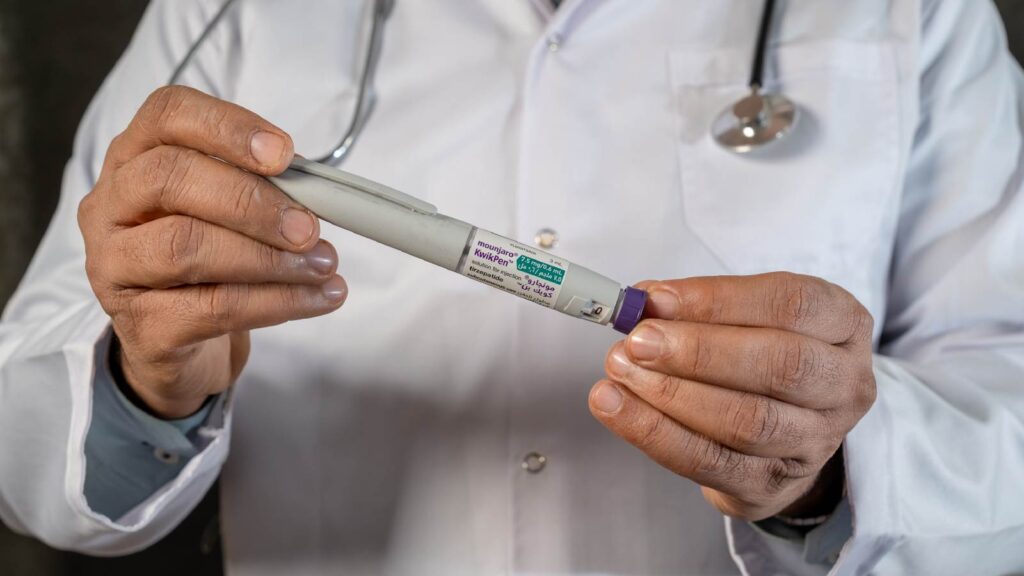
Rollout has been slow, and the drug is still not available in parts of the country. In many cases, funding for tirzepatide allocated to ICBs by NHS England doesn’t match the estimated number of people eligible, local population health data show. Source: BMJ
This is creating a two-tier system which risks significantly exacerbating health inequalities. Source: BBC
Anecdotally, we hear that GPs are under significant pressure from patients to give them access to the drugs, and ICBs are swamped by associated complaints and FOI requests at a time when their staffing is being cut significantly.
It doesn’t help that systems are starting from very different places, with historic commissioning arrangements for weight management services often patchy and inconsistent.
There is also the question of long-term sustainability, with evidence suggesting that many people will simply regain any weight lost once they stop taking the medication. Is it really feasible for the NHS to fund these medicines long-term, when 64% of adults in the UK are overweight or living with obesity? Source: Office for Health Improvement and Disparities
So how do systems make sense of this complex, even chaotic, picture and make the most of the opportunities this revolutionary new treatment can offer to improve health equity and population health outcomes?
ICBs across the country are grappling with that question. From January 2025 to July 2026, we have been providing structured, evidence-informed support to the West and North London Integrated Care Board (ICB) to implement an effective weight management pathway.
Our approach has included:
- Optimising the use of existing assets, understanding the local context and building on existing infrastructure and expertise rather than starting from scratch
- Working with clinical leads to identify, stratify and prioritise eligible patients, improving health equity and population health outcomes
- Carrying out thorough quality and equality impact assessments
- Developing business cases that demonstrate return on investment, setting out what can be realised in the short term and where longer-term health economic analysis is needed
This will remain a fast-evolving picture for years to come. These treatments are new and still emerging – with the first oral GLP-1 medication recently approved.
The government’s 12 new projects test new models of care and speed up access to treatment and will run until March 2029.
The projects are deliberately varied: AI-assisted triage, self-referral pathways, personalised care supported by digital tools, whole-family approaches to obesity, and delivery through neighbourhood hubs and community pharmacies, with a consistent focus on underserved communities. This is an exciting opportunity to build the real-world evidence that will shape future commissioning and could benefit millions. In the short term, though, it also risks deepening the fragmentation and inequity in access that systems are already wrestling with.
From 2026/27, obesity care GPs are incentivised to provide obesity care through two new QOF indicators, backed by around £25 million: one for referral to weight management services, one for shared decision-making and prescribing, including weight-loss medication. Responsibility for prescribing tirzepatide is now increasingly likely to fall to general practice, where practices can choose whether or not to deliver against the QOF indicators. That is an opportunity to widen access, but a hard one to realise against rising GP workloads. And because QOF participation is voluntary, uptake is likely to be variable, which brings real quality and health equity risks that commissioners have few levers to manage.
It’s also been confirmed that ICBs must make semaglutide available by August 2026 to reduce the risk of major cardiovascular events, such as heart attack and stroke, in people with established cardiovascular disease who are overweight or living with obesity. NHS England estimates this could reach more than a million people. It is a real opportunity to improve population health, cut cardiovascular risk and save lives. But it lands as another demand on already pressured ICBs and providers, short of clinical and managerial capacity and working to stretched budgets.
“Would strongly recommend TPHC to any colleagues across the NHS. They have been invaluable in supporting our programme of work and would use them again for any additional support that is needed.”
Hannah Logan, Public Health Consultant, WNL ICB
With the new innovation projects, the QOF incentives and the cardiovascular rollout all arriving at once, systems are facing more change than their capacity easily allows. They need a delivery partner who can help them navigate the uncertainty and build pathways that turn these opportunities into better care for patients. That is where we come in.
To talk through how we could work with you, offering strategic support and hands-on programme delivery tailored to your context, get in touch with our consulting team.